
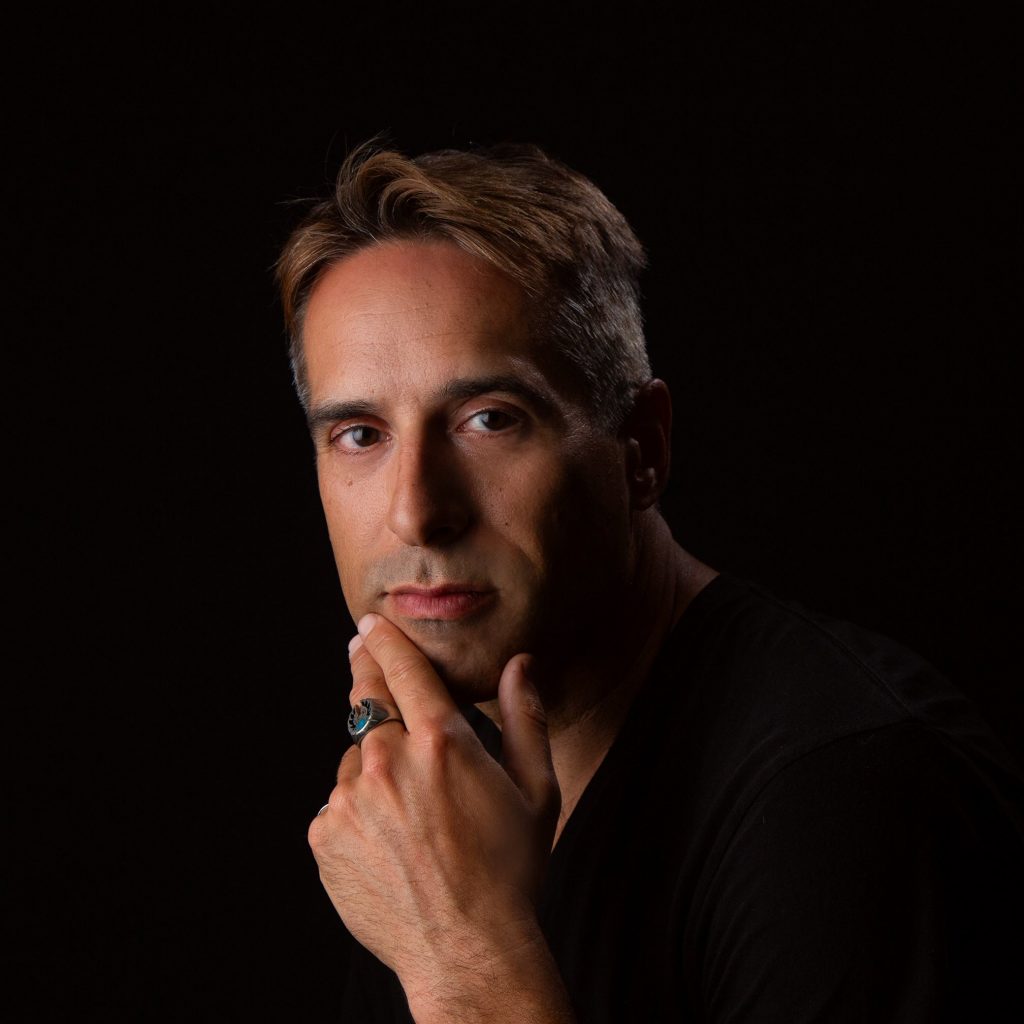
ARTIST BIO
Matt Deifer (pronounced “DYE-fer”) is a multidimensional artist whose work spans fine art, photography, bodypainting, scenic art, and immersive environments. He has created large-scale visual worlds for festivals, museums, and select film, television, and commercial productions while maintaining an evolving fine art practice. His career moves fluidly between art direction and hands-on execution, with contributions to campaigns, music videos, public art projects, and experiential installations.
Originally from the Philadelphia area and shaped by a decade in Los Angeles, Matt explores the intersection of art, sensory experience, and personal transformation through projects that blur the lines between participation, performance, and visual art.
In 2010, he founded Bodypaint.Me, a bodypainting and participatory art platform through which he has produced public art activations, developed custom blacklight bodypaint products, and created original concepts including The Human Scrapbooking Experience and THE THING, a blacklight bodypaint dance party.
ARTIST STATEMENT
My work explores how art can shift perception and reconnect people to themselves. I’m drawn to the places where intuition, symbolism, and sensory experience overlap, and I use fine art, photography, bodypainting, and immersive environments to investigate those thresholds.
I’m interested in how color, light, and the human body can open internal space, and how an image, gesture, or constructed environment can create a moment of presence. Much of my practice is about inviting people to feel more, notice more, and step briefly outside the patterns that keep them on autopilot.
Whether I’m building an installation, painting a figure, or developing a photographic series, I’m searching for the same thing: a sense of expansion, curiosity, and connection. My work is an ongoing attempt to translate that experience into form.
SELECTED VENUES
Houdini Estate • Nobu Malibu • Waldorf Astoria Beverly Hills • Hollywood Roosevelt • Pacific Design Center • Delaware Center for the Contemporary Arts • Brooklyn Masonic Temple • Battleship New Jersey Museum & Memorial • Coachella • EDC Las Vegas • Lightning in a Bottle • Lost Lands • Nocturnal Wonderland • Playboy Mansion • Museum of Contemporary Art San Diego • Please Touch Museum • African American Museum • Central Park • Webster Hall • Music Hall of Williamsburg • Wells Fargo Center • DC Armory
CREATIVE LINEAGE
My creative path has always been shaped by the same three forces: play, imagination, and community. From a daycare-filled home in Pennsylvania to festivals, nightlife, immersive installations, and beyond, every chapter has built on the last.
Coplay: Foundations in Play, Imagination & Community
Matt’s creative life began in Coplay, Pennsylvania, where his mother ran a daycare out of their home from the day he was born until he was fifteen. Growing up in a space filled with play, imagination, and constant social interaction shaped his instincts for guiding groups, building community, and creating environments where people feel expressive and free. He was always drawing, building, and turning whatever materials were around into characters, scenes, and improvised worlds. That early mix of creativity, play, and social energy shaped the way he approached art. It also set the stage for his formal training at Barnstone Studios, where he studied classical figure drawing, still lifes, geometric construction, and the golden ratio method. The Barnstone approach gave him a disciplined understanding of proportion and visual structure, and it became a quiet foundation for the way he now builds space, composes images, and designs immersive environments.
Ithaca: Cultural Fusion and the Roots of Experiential Art
Matt’s creative path expanded in Ithaca, where he produced concerts and underground events, played an intrinsic part in starting the See Spot Art Gallery in the Ithaca Commons, and launched his first company, Eis Productions. He ran street teams and guerrilla marketing for major regional events and managed the audio and visual department at Ithaca College, gaining early experience in production, community building, and creative logistics. Alongside this work, he continued developing his visual art practice through fine‑art electives, often painting the gorges and sacred waterfalls around the region. He was drawn to the shifting light and atmosphere of the landscape, exploring Impressionist influences like Monet while beginning to lean into the emotional immediacy of Expressionism. This period helped bridge the classical structure he learned in Coplay with a more intuitive, color‑driven approach to painting.
During this era, he became one of the early figures connecting the jam‑band festival world with the emerging rave and live‑electronic scene. He produced shows that blended audiences, supported early hybrid acts, and brought festival‑style interactivity into clubs while introducing electronic culture to jam‑band environments. This fusion grew naturally from his teenage years touring with Phish, where he absorbed the improvisational, communal, and sensory elements that would later shape his creative approach. After completing the Ithaca chapter, Matt returned to the Lehigh Valley, where the next evolution of his work was already beginning to take shape through a new partnership emerging in New York City.
Bethlehem and Skyetop: Festivals, Community and Cross‑Genre Culture
In Bethlehem, Matt reconnected with both his festival roots and the emerging electronic scenes of the Northeast. This was the period when his early live art experiences began to take shape. He started painting live at events before it became common and created interactive art experiences at festivals and in other venues, bringing festival‑style energy into intimate spaces. These experiments blended jam band improvisation, rave culture, and the visual language of early burner communities, forming the foundation of the experiential work he would later become known for.
As his live art practice emerged, he co‑created Skyetop, a one-hundred-acre private property in Upstate NY that rapidly evolved into a sold out six-thousand-person festival. The growth was rapid, fueled by the convergence of his Ithaca connections, Lehigh Valley base, and early Philadelphia networks. Skyetop sat on sacred Native American land, and sustaining a festival of that scale would have required major infrastructure, new roads, and permanent alterations to the landscape. Rather than disrupt the natural order of the land, the team chose to preserve it, and the Skyetop dream ended after its breakthrough year. This moment became a defining part of Matt’s early creative lineage and set the stage for the next evolution of his work.
After Skyetop, Matt created a hand painted visual identity system for Lotus at a moment when the band was stepping into a new phase of its evolution. The ten-panel series became the band’s visual identity for this era, shaping the album, the tour posters, the website artwork, and the overall aesthetic of The Strength of Weak Ties. The paintings unified the entire release and visually supported the band’s first sold-out tour, giving Lotus a distinct visual world at a pivotal point in their rise. This identity became a defining part of how the band presented itself throughout that period.
Indaglo, Mr. Imagination and NYC: Nightlife, Hip Hop and Media
During this same era, Matt partnered with a New York based collaborator to launch Indaglo Inc., entering the top tier of hip hop, R&B, and celebrity nightlife while still connected to the festival and rave communities that shaped his early years. Indaglo produced high profile events across the Northeast and appeared on an MTV reality show that followed the team while throwing parties in Las Vegas and Miami. Matt produced the first hip hop day at Musikfest, headlined by Ne Yo and LL Cool J, and worked directly with artist managers to produce shows with Method Man, Ciara, Jim Jones and others. This period immersed him in a media driven nightlife world shaped by celebrity photography, performance culture, and rapid-fire production.
While this partnership was unfolding, Matt formed a close creative friendship with the legendary visionary folk artist Mr. Imagination. Working together in Mr. I’s Bethlehem studio, they created hybrid works that blended Matt’s experimental backgrounds with Mr. I’s iconic sculptural language. Mr. Imagination built a throne installation for one of Matt’s Indaglo red carpet events and gifted Matt several personal pieces that remain central to his artistic lineage.
As Indaglo expanded, the nightlife world around it grew increasingly shaped by competition, ego, and the sharper edges of celebrity‑driven culture. Matt entered the scene believing he could bring creativity, community, and positivity into a space that was rapidly shifting toward something far more volatile. Over time, it became clear that the environment was moving in a direction he could not influence, and he chose to step away rather than be pulled deeper into a world that no longer aligned with his values. This turning point pushed him back toward the playful, participatory, and imaginative roots that had defined his earliest work, setting the stage for the creation of Funtown.
Philadelphia: Funtown, Tiberino Museum & the Spirit of Play
Leaving Indaglo created space for Matt to realign with the parts of himself rooted in play, community, and electronic culture, which led him to Philadelphia. He began producing events again and discovered hoop dancing at a time when it was still emerging. He was one of the first to embrace glow hooping, helping transform it from a children’s toy into a full‑scale performance phenomenon. He integrated them into his events, where they became a defining visual element. He brought hoop dancers into stage performances with national touring acts and into the crowd as interactive performers. Festival culture quickly adopted the idea and the movement grew.
At the center of this era was his new company Funtown, a ‘state of mind’ built around the idea of helping people reconnect with their inner child and sense of play. The focus was on interactive activities, performance art, and environments that encouraged imagination and participation.
As Funtown expanded, the entire creative ecosystem transitioned into the Tiberino Museum, a landmark institution in Philadelphia’s art world and a central hub for multigenerational creativity. Matt established both a home and a studio space on the property, becoming part of the daily rhythm of the compound and its creative community. The museum became the birthplace of his bodypainting practice, a spontaneous experiment that took off immediately and rapidly became a defining part of his identity. He launched Bodypaint.Me, and the practice quickly became one of the defining threads of his creative evolution.
As his work expanded inside the museum, Matt produced a series of Glow Garden events in the courtyard, transforming the space with blacklight bodypainting, glowing color installations, aerialists, dancers, glow hoopers, and fire performers that wrapped around the museum’s architecture. His presence within the compound was further cemented when Joe Tiberino painted Matt directly into his mural at Philadelphia City Hall, symbolizing his place within the Tiberino’s living history. This era also marked the beginning of his relationship with Crayola, including programming their public festivals, birthday celebrations, and New Year’s Eve events in downtown Easton. These projects featured magic shows, stilt walkers, hoop dancers, jugglers, globe‑walkers, giant bubbles, and interactive art from his Funtown Productions team, bringing his immersive creative work into a major public setting and expanding his practice beyond nightlife into family‑friendly environments. The Tiberino era became a bridge between his Funtown roots and the immersive worlds he would later build in Los Angeles.
As his work expanded, Matt began conceptualizing and producing large‑scale characters and interactive costumes for onstage performances, including a full Kool‑Aid Man suit that burst through a fake brick wall on stage, as well as Party Owl and Grumpy Cat. He also collaborated on a large arena‑scale activation at the Liacouras Center, contributing creative direction and promotional strategy for a 6,000‑person event. For the encore, he created a massive pink elephant that moved through the crowd, and provided a 35‑person performance crew of roller‑skaters, bodypainters, glow‑hoopers, costumed characters, totem‑makers, and dedicated entertainers he directed on site. These projects blended theatrical spectacle, immersive art, and hands‑on production, reflecting the playful spirit that defined the Funtown era.
Next, Matt moved to Northern Liberties and expanded into a larger art studio in Port Richmond. He teamed up with Actual Records and co‑produced a series of dubstep events in clubs throughout Philadelphia. These events played a meaningful role in the early rise of the genre in the United States and helped introduce a new sound to a wider audience. This new sound was the wave that made electronic music mainstream in the United States. At the same time, he and his extended team produced a long‑running series of warehouse after‑hours events that consistently drew hundreds of people and became a central gathering point for Philadelphia’s electronic community.
Throughout all of this, his bodypainting work grew rapidly. What started as an experiment ultimately shaped the direction of his creative career. He created work for national commercials, magazine covers, large events across the Northeast, and for tv shows in Japan and Europe. His performers often became his models and collaborators. This momentum expanded into large public projects, including co-producing the Philly Naked Bike Ride for six years and building a fifty-artist bodypainting crew for the protest that drew thousands and international press.
As his work evolved, Matt understood he had outgrown Philadelphia’s creative ceiling. To reach a larger audience and step into a larger commercial market, he made the decision to relocate to Los Angeles.
Los Angeles: Bodypainting, Locations, Studios, Immersive Worlds, Malibu and Fabrication
Matt’s Los Angeles era unfolded in four major phases that built on one another.
Phase One: Bodypainting, Location Agency and the Studio Complex
When Matt arrived in Los Angeles, he elevated his bodypainting career by taking on high profile commercial and entertainment projects. He then launched a film and event location agency, Cinematic Locations, that represented a portfolio of unique properties across the city. He worked with clients such as Google, Def Jam, Hot Topic, and major production companies, hosting events, photo shoots, commercials, and music videos. This work eventually led to him becoming a partner in CTC Studios, a twenty thousand square foot film and event studio complex.
During this period, Matt also began experiencing a deep spiritual awakening and a return to nature. The quiet moments between projects became a space for reflection, healing, and internal transformation. He became obsessed with the desert’s dark skies and learned how to capture the milky way through astrophotography and sold and exhibited the prints in art galleries.
When COVID arrived, the entire film and event industry shut down. Bodypainting was illegal. Over the next year, the Los Angeles film and event world contracted significantly, and the studio business became difficult to sustain. As the industries shifted, Matt began exploring new creative directions.
Phase Two: Immersive UV Installations & Art Department Work
As film production migrated overseas and the location rental industry in Los Angeles dwindled, Matt began creating 3D blacklight immersive experiences for Nocturnal Wonderland, Lightning in a Bottle, Lost Lands, and other major festivals throughout the country. These hand‑painted environments continued the experiential art lineage he began in Ithaca and became a recognizable part of the immersive festival landscape. He worked on these installations for several years and developed a strong presence in this space, often performing inside them by bodypainting as part of the installation itself, turning the environments into living, interactive UV worlds. Throughout these years, he also worked in the art departments of major television shows and films and art directed music videos, expanding his creative practice into large‑scale scenic work and on‑set production environments alongside festival installations.
Phase Three: The Malibu Ranch and the Development Vision
Parallel to this work, Matt lived and worked on a twenty-acre ranch in Malibu. His partnership role positioned him as the superintendent and development consultant for the project, overseeing day‑to‑day operations and long‑term planning as the property was being developed into a wellness retreat and a series of spec homes. This period deepened his spiritual awakening and strengthened his connection to nature, land, and quiet living.
In this quiet, reflective stretch, Matt also worked with Paul Stanley as a painter and studio assistant in his Los Angeles art studio. Together, they created art sold exclusively through Wentworth Galleries nationwide. This work placed him inside a high‑output fine art environment and expanded his experience in mixed media production, studio discipline, and large‑scale creative workflows.
Phase Four: The Palisades Fire and the Shift into Fabrication
Then in a one-month period, Deifer was evacuated from the ranch by two historic wildfires. The Franklin Fire and the Palisades Fire. Both tore through the canyon system beside the ranch, burning the surrounding area within a mile in multiple directions. Even the areas that survived were left coated in toxic ash, smoke, and contaminated soil. In the months that followed, mudslides, debris flow, and slope failures repeatedly shut down the main highway into Malibu, leaving the region functionally cut off for nearly a year and collapsing the local economy. The development project ended, and the fire abruptly interrupted the healing and spiritual clarity Matt had been building. It marked a defining turning point in his life.
Directly after the fire, Matt continued his commercial bodypainting work while stepping into a completely different tier of production: large‑scale custom fabrication and presenting-sponsor brand activations for festivals such as Coachella and EDC Las Vegas. This work was not part of his immersive 3D blacklight installations. It operated on an industrial scale, involving massive custom steel structures, full nightclub‑style environments, integrated lighting and sound systems, bars, interactive projections, and multi‑team construction workflows. Matt worked across fabrication crews, scenic teams, and on‑site production coordination, contributing to builds that functioned as full architectural installations rather than art environments. After completing this high‑intensity festival season, he chose to leave Los Angeles.
Recovery, Reinvention & Human Scrapbooking
After leaving Los Angeles, Matt entered a period of recovery, reflection, and reinvention. Years of intense production, personal setbacks, a major injury, the collapse of the Malibu development project, and the disruption caused by multiple historic wildfires created an opportunity to step back and reassess the direction of his life and work.
During this period, he focused on rebuilding from the ground up. He returned to painting, photography, creative experimentation, and the development of entirely new participatory art formats. The slower pace provided space to reconnect with the core themes that had been present throughout his creative life: play, imagination, transformation, and community.
It was during this transition that he developed his own custom blacklight bodypaint products and created The Human Scrapbooking Experience, a participatory art form that transforms guests into living scrapbooks through vintage rubber stamps, handcrafted blacklight makeup, glow stickers, and glitter.
The period also saw the emergence of THE THING, a blacklight bodypaint dance party built around participation, creativity, and sensory exploration. Together, these projects marked the beginning of a new chapter, one focused less on building worlds for other people and more on creating original concepts rooted in decades of experience across art, events, bodypainting, fabrication, and immersive culture.
Rather than serving as a destination, this chapter became a period of consolidation, healing, and creative rediscovery. Many of the ideas that had emerged across previous decades of work finally came together in a form that was uniquely his own.
As Human Scrapbooking and THE THING gained momentum throughout the East Coast, they reconnected Matt with creative communities, collaborators, and opportunities that had been years in the making. What began as a period of recovery and reinvention became a bridge back home, ultimately setting the stage for a return to Pennsylvania and the next chapter of his creative journey.